



Where is hip arthritis pain felt? Hip osteoarthritis is often associated with deep pain in the groin or front of the hip, but discomfort may also be felt in the thigh, outer hip, buttock, knee, or nearby areas. This happens partly because pain originating in the hip joint can be perceived elsewhere. Pain location alone, however, cannot diagnose hip arthritis.
Other problems involving the hip, surrounding tendons and muscles, pelvis, lower back, or nerves can produce similar symptoms.
Hip Arthritis Pain Doesn’t Always Feel Like “Hip Pain”
The hip joint sits deep within the body where the upper end of the thighbone meets the pelvis. Because the joint is not located directly beneath the skin on the outside of the hip, pain coming from inside the joint may not occur where many people expect.
Hip osteoarthritis commonly causes pain and stiffness. The American Academy of Orthopaedic Surgeons notes that groin pain is particularly common and that pain may extend into the thigh, buttocks, or knee. The National Institute of Arthritis and Musculoskeletal and Skin Diseases also describes hip osteoarthritis pain in the hip joint, groin, inner thigh, buttocks, and sometimes the knee.
This phenomenon is known as referred pain. In simple terms, the location where your brain perceives discomfort is not always exactly where the underlying problem originates.
Key takeaway: Hip-joint problems frequently produce groin or front-of-hip discomfort, but hip-related pain may also be felt in the thigh, buttock, or knee.
Researchers studying patients with confirmed hip osteoarthritis have documented considerable variation in pain distribution, which is another reason physicians evaluate the overall symptom pattern rather than relying on one painful spot.
7 Common Places Hip Arthritis Pain May Be Felt
1. Groin or Inner Hip
Groin pain is one of the more characteristic locations associated with problems arising from inside the hip joint.
Someone with hip-joint irritation may describe a deep ache, pressure, stiffness, or discomfort where the upper thigh meets the pelvis rather than pain directly on the outside of the hip.
Symptoms may become more noticeable with activities that require the hip to bear weight or rotate, such as:
- Walking
- Standing for longer periods
- Turning or pivoting
- Getting up from a chair
- Getting into or out of a vehicle
- Climbing stairs
- Putting on shoes or socks
AAOS identifies the groin as the most common pain location associated with hip osteoarthritis.
That does not mean every episode of groin pain is arthritis. Problems involving muscles, tendons, the abdominal or pelvic region, other hip conditions, and several nonorthopedic conditions may also produce discomfort there.
If groin pain is persistent, is accompanied by hip stiffness, or is beginning to interfere with walking and everyday movement, an orthopedic evaluation can help determine whether the hip joint may be involved.
2. Front of the Hip
Hip arthritis may also be associated with aching, stiffness, or deeper discomfort at the front of the hip.
Because several muscles and tendons cross this area, patients sometimes assume that front-of-hip discomfort is simply a strained muscle or hip-flexor problem.
Sometimes it is. Sometimes the joint itself may be contributing.
Pain from inside the hip may become noticeable when repeatedly bending the hip, transitioning from sitting to standing, climbing stairs, or getting into a low vehicle.
The pattern becomes more informative when physicians consider it alongside range of motion, stiffness, functional limitations, examination findings, and imaging when appropriate.
For a broader discussion of conditions that may cause pain around the hip, see Hip Pain: Common Causes & Treatments.
3. Front or Upper Thigh
Hip osteoarthritis can produce referred pain into the front or upper thigh.
In some people, the thigh may actually be more noticeable than what they would describe as “hip pain.”
That can make the source confusing. A person may focus on the thigh because that is where the discomfort is felt, even though the hip joint is one structure that needs to be considered during an evaluation.
Published studies of people with hip osteoarthritis have documented anterior and lateral thigh pain as part of the symptom distribution.
Thigh discomfort can also come from muscles, tendons, the lower back, nerves, circulation problems, previous injuries, and other sources. A clinician therefore looks beyond location and asks questions about when symptoms occur, what movements reproduce them, whether numbness or tingling is present, and how the hip and spine move during examination.
4. Outside of the Hip
Pain directly over the outside of the hip is less specific for arthritis inside the hip joint.
Some people with hip osteoarthritis do report lateral or outer-hip discomfort. Research confirms that pain around the greater trochanter—the bony area you can feel along the outside of the hip—can occur in patients with hip OA.
However, this region is also home to important tendons and other soft tissues.
Conditions grouped under terms such as greater trochanteric pain syndrome can produce tenderness or pain over the outer hip. Bursae in this region may sometimes be involved, but not every case of outer-hip pain should automatically be labeled “bursitis.”
This distinction matters because a problem involving the joint itself may require a different treatment strategy than a problem involving the tissues surrounding the joint.
An examination can help identify whether pain appears to be coming primarily from inside the joint, surrounding soft tissues, or potentially more than one structure.
5. Buttock
Hip conditions can sometimes cause discomfort in the buttock, but buttock pain has many possible sources.
Hip osteoarthritis pain distributions documented by both government and orthopedic sources include the buttock.
At the same time, discomfort in this region may also be related to:
- The lumbar spine
- The sacroiliac region
- Muscles or tendons around the pelvis and hip
- Other musculoskeletal structures
This is where the distinction between hip and spine problems can become especially challenging.
Someone with arthritis visible on a hip X-ray can still have a separate back condition. Likewise, someone experiencing buttock discomfort may have no significant hip-joint disease at all.
Clinicians therefore evaluate how the hip and spine behave together rather than assuming that buttock pain identifies one specific diagnosis.
6. Knee
Yes, a problem originating in the hip can sometimes be felt around the knee. This is called referred pain.
This can be one of the most surprising hip arthritis pain locations.
Because the knee hurts, a patient may understandably assume the problem must be inside the knee. But the nervous system can sometimes cause pain from the hip joint to be perceived farther down the thigh or around the knee.
NIAMS specifically notes that arthritis pain in the hip can sometimes spread to the knee, and clinical studies have documented knee pain among patients with confirmed hip osteoarthritis.
That does not mean knee pain usually indicates hip arthritis. Knee arthritis, meniscus problems, tendon conditions, injuries, and many other knee-specific problems are far more direct possibilities.
The practical lesson is simply this: if the knee itself does not fully explain the symptoms—or if knee discomfort occurs together with groin pain, hip stiffness, difficulty rotating the hip, or trouble getting into a vehicle—the hip may deserve evaluation as part of the diagnostic process.
7. Lower Back, Leg, or Overlapping Areas
Pain involving the hip region, lower back, buttock, thigh, and leg can overlap enough that determining the source sometimes requires a detailed examination.
Symptoms such as numbness, tingling, burning, or neurologic-type sensations, particularly when they extend substantially down the leg, may cause a clinician to consider spinal or nerve-related sources in addition to the hip.
Research comparing hip osteoarthritis with lumbar spinal stenosis found that symptoms such as tingling or numbness and pain below the knee tended to favor a spinal source, while groin pain and difficulty with activities such as getting into a car or dressing the affected leg were more suggestive of hip disease. These are clinical clues—not diagnostic rules.
There is another important nuance: hip-joint pain can occasionally extend below the knee, so even this distinction is not absolute.
That is why physicians combine the history, examination, mobility testing, imaging, and sometimes additional diagnostic studies rather than diagnosing a hip or spinal condition based solely on a pain map.
Hip Arthritis Pain Location at a Glance
| Pain Location | Can Hip Arthritis Be Associated With It? | Other Possible Sources |
|---|---|---|
| Groin | Commonly associated | Other hip, groin, pelvic, or soft-tissue conditions |
| Front of hip | Possible | Hip flexor and surrounding soft tissues |
| Upper/front thigh | Possible referred pain | Muscle, nerve, spine, or other causes |
| Outer hip | Possible but less specific | Tendons and other lateral soft tissues |
| Buttock | Possible | Spine, SI region, muscles, tendons |
| Knee | Possible referred pain | Knee-specific conditions |
| Lower back/leg | Less specific | Spine, nerve, hip, or overlapping conditions |
This table is useful for understanding possible patterns, not for diagnosing the cause of pain at home.
What Does Hip Arthritis Pain Typically Feel Like?
Hip osteoarthritis symptoms vary from one person to another, but commonly described patterns may include:
- A deep or dull ache
- Stiffness
- Pain with walking or other weight-bearing activity
- Stiffness after sitting or resting
- Reduced hip motion
- Difficulty rotating the leg
- Discomfort on stairs
- Difficulty getting into or out of a vehicle
- Trouble bending down to put on shoes or socks
- Limping as symptoms become more limiting
AAOS notes that hip osteoarthritis often develops gradually and may cause worsening pain and stiffness, reduced range of motion, and difficulty walking or bending.
Some people experience substantial pain while others are affected more by stiffness and loss of movement. Symptoms and imaging findings also need to be interpreted together rather than assuming the amount of pain precisely reflects what an X-ray will show.
Hip Pain or Back Pain? Why It Can Be Difficult to Tell
Hip-joint problems and lumbar-spine problems can cause symptoms in some of the same areas.
Both may produce discomfort involving the groin, buttock, thigh, leg, or even knee. Patients can also have a hip problem and a back problem at the same time.
Clinicians may consider clues such as:
- Whether groin pain is prominent
- Whether hip rotation is restricted or painful
- Whether putting on shoes or socks has become difficult
- Whether getting into or out of a vehicle causes pain
- Whether symptoms include numbness or tingling
- Whether discomfort travels substantially down the leg
- Whether movements of the hip or spine reproduce symptoms
These are not self-diagnostic tests.
Orthopedic literature on hip-spine syndrome emphasizes the importance of a thorough history, physical examination, and appropriate imaging because the conditions can overlap considerably.
How Does an Orthopedic Specialist Determine Where the Pain Is Coming From?
An orthopedic evaluation looks at the entire clinical picture, not simply where you point when asked, “Where does it hurt?”
Depending on your symptoms and medical history, the evaluation may include:
- A detailed medical and orthopedic history
- Discussion of where pain begins and where it travels
- Activities that trigger or relieve symptoms
- Walking and mobility assessment
- Hip range-of-motion testing
- Strength testing
- Examination of surrounding muscles and tendons
- Assessment of the back or knee when relevant
- X-rays when appropriate
- Additional imaging or diagnostic testing when clinically indicated
AAHKS describes medical history, physical examination, and X-rays as central components in determining whether symptoms are related to osteoarthritis.
The purpose is to answer a more useful question than simply “Does the hip hurt?”:
Which structure is actually responsible for the symptoms?
Does Hip Arthritis Pain Mean You Need a Hip Replacement?
No.
Pain compatible with hip arthritis does not automatically mean hip replacement is necessary.
Not all hip pain is osteoarthritis, and even when arthritis is present, treatment decisions depend on the individual. AAHKS emphasizes that management generally progresses from less-invasive options toward surgery when appropriate rather than treating every patient with arthritis the same way.
Hip replacement may eventually become part of the discussion when several factors occur together, such as:
- Significant deterioration of the joint
- Persistent symptoms
- Loss of mobility
- Meaningful functional limitations
- Reduced quality of life
- Insufficient improvement with appropriate nonsurgical care
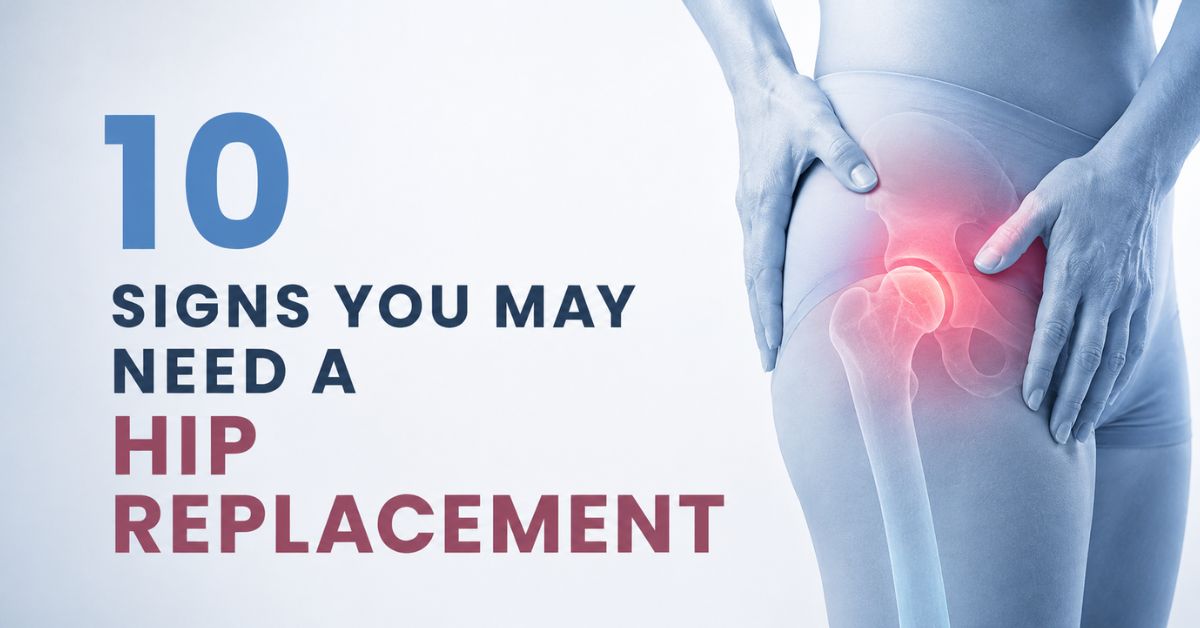
If your main question is whether your symptoms have progressed to the point that a replacement evaluation may be appropriate, see 10 Signs You May Need a Hip Replacement.
Even significant pain or advanced arthritis on an X-ray does not automatically determine the decision. AAHKS recommends considering pain, function, imaging, previous treatment, and the effect arthritis is having on everyday life.
When Should Hip Pain Be Evaluated?
Consider scheduling an orthopedic evaluation when pain, stiffness, or reduced hip motion is:
- Persistent
- Becoming more frequent
- Affecting the way you walk
- Limiting everyday activities
- Interfering with sleep
- Causing you to limp
- Reducing hip movement
- Making shoes or socks difficult to put on
- Making it harder to get into a vehicle
- Affecting your independence or quality of life
You do not have to determine whether the source is arthritis before making an appointment. Determining the cause is part of the evaluation.
When Hip Pain May Need More Urgent Attention
Sudden severe pain, significant trauma, inability to bear weight, fever accompanied by marked redness or swelling, obvious deformity, or other concerning acute symptoms may require more prompt medical evaluation.
If you are unsure about the urgency of a new or severe symptom, seek appropriate medical advice rather than relying on symptom location alone.
Hip Arthritis Evaluation in Meadville and Erie, Pennsylvania
Whole Health Orthopedic Institute provides specialized evaluation and treatment for patients experiencing hip pain, arthritis, stiffness, limited mobility, and other orthopedic concerns throughout Meadville, Erie, Crawford County, Erie County, Northwestern Pennsylvania, and surrounding communities.
Patients can schedule directly.
No Referrals Necessary.
For patients who ultimately require joint replacement, Whole Health Orthopedic Institute provides advanced hip replacement care, medical optimization, individualized surgical planning, and same-day or outpatient pathways for appropriately selected patients.
Patients researching surgical options locally can also learn more about hip replacement surgery in Erie, PA or hip replacement in Meadville, PA.
Schedule Your Consultation
Call 1-833-HIP-KNEE
A Whole-Patient Approach to Hip Care
Finding the source of hip-area pain is only the beginning.
Whole Health Orthopedic Institute combines specialized orthopedic care with patient education, medical optimization, whole-body preparation, personalized treatment planning, and a guided patient experience.
When surgery is appropriate, patients also have access to advanced hip and joint replacement expertise, including same-day or outpatient pathways for properly selected individuals.
For some patients requiring hip replacement, THE Beach-Cut Hip™ may be one surgical option discussed during personalized treatment planning. The appropriate approach depends on the patient’s diagnosis, anatomy, medical health, goals, and other individual factors.
Not everyone with hip pain needs surgery, and not every surgical patient is an appropriate candidate for the same procedure or outpatient pathway.
Frequently Asked Questions About Hip Arthritis Pain
Where is hip arthritis pain usually felt?
Hip arthritis pain is commonly felt in the groin or front of the hip. It may also be experienced in the thigh, buttock, outer hip, or knee because pain from the hip joint can sometimes be referred to surrounding areas. Pain location alone cannot determine whether arthritis is present.
Is groin pain common with hip arthritis?
Yes. Groin pain is one of the more characteristic pain locations associated with hip osteoarthritis because problems arising inside the hip joint are frequently perceived in the groin. However, groin pain can have many other orthopedic and nonorthopedic causes, so persistent symptoms should be properly evaluated.
Can hip arthritis cause pain down the thigh?
Yes. Hip osteoarthritis can be associated with referred pain into the front or upper thigh. Some patients notice thigh discomfort more than pain directly around the hip. Muscle, nerve, spine, and other conditions may cause similar symptoms, so the location does not establish a diagnosis.
Can hip arthritis cause knee pain?
Yes, in some patients. Pain originating in the hip joint can occasionally be perceived around the knee. This is known as referred pain. Knee pain has many potential causes, however, and most knee pain should not automatically be assumed to originate from hip arthritis.
Can hip arthritis cause buttock pain?
Hip osteoarthritis can be associated with buttock discomfort, but this location is not specific to the hip joint. Lower-back conditions, the sacroiliac region, muscles, tendons, and other structures can also produce pain in the buttock.
How can you tell the difference between hip arthritis and back pain?
There is no single symptom that reliably separates the two. Groin pain, loss of hip rotation, or difficulty getting into a car may point clinicians toward the hip, while numbness, tingling, or certain radiating leg symptoms may raise concern for the spine. Examination and imaging may be needed because the conditions can overlap.
What does severe hip arthritis feel like?
More advanced hip arthritis may be associated with persistent aching, stiffness, loss of motion, pain during everyday activity, difficulty walking, nighttime discomfort, and increasing functional limitations. Symptom severity varies considerably, and the degree of pain alone does not establish how advanced arthritis is.
Does hip arthritis pain mean I need a hip replacement?
No. Arthritis symptoms do not automatically mean hip replacement is necessary. Treatment decisions depend on the diagnosis, severity of joint damage, mobility, functional limitations, health, goals, response to appropriate nonsurgical treatment, and the overall impact on quality of life.
Medically Reviewed By
Ryan G. Molli, DO, FAAHKS, FAAOS
Dr. Ryan G. Molli is the Founder and Chief Executive Officer of Whole Health Orthopedic Institute and specializes in Adult Reconstruction and Total Joint Replacement. His clinical work focuses on hip and knee reconstruction, advanced joint replacement, patient education, medical optimization, orthopedic research, and the complete joint replacement experience.
This article is provided for general patient education and is not a substitute for individualized medical evaluation, diagnosis, or treatment.
Medical Information & References
Medical information for this article was informed by patient education and clinical literature from the American Academy of Orthopaedic Surgeons, National Institute of Arthritis and Musculoskeletal and Skin Diseases, American Association of Hip and Knee Surgeons, and peer-reviewed studies indexed in PubMed concerning hip osteoarthritis pain distribution and the overlap between hip and lumbar-spine symptoms.
Find Out What’s Causing Your Hip Pain
Pain in the groin, thigh, buttock, knee, or surrounding areas does not automatically mean you have hip arthritis.
If persistent discomfort or stiffness is affecting your mobility or everyday activities, an orthopedic evaluation can help determine where your symptoms are coming from and which treatment options may be appropriate.
No Referrals Necessary
Whole Health Orthopedic Institute serves patients in Meadville, Erie, Crawford County, Erie County, Northwestern Pennsylvania, and surrounding communities.